Overview
Befriend is a conceptual AI-powered relationship assistant that helps people reflect on emotional patterns and navigate difficult interactions. The project explores how contextual memory can make AI guidance feel more continuous, specific, and useful over time.
How might AI help people navigate emotionally complex interactions and reflect on recurring relationship patterns?
Introduction
Modern connections are filled with moments that are emotionally nuanced but often hard to articulate. People commonly turn to friends, note-taking apps, or online advice for clarity, but these options are not always available or unbiased.
Befriend explores how an AI-powered assistant could fill this gap, helping users decode interactions, reflect on emotional patterns, and support their emotional lives around the clock. The central question guiding this work was: How might AI help people navigate their real-life relationships?
To explore this, I analyzed how people currently seek clarity and emotional support, identified gaps in existing tools, and experimented with AI-generated personas to simulate real-world emotional contexts, extending the reach of traditional UX research.
Research
To understand how people seek clarity and reassurance in relationships, I conducted 5 semi-structured interviews with users of dating apps who already leverage AI in their communication workflows. Participants described using AI to draft replies, refine tone, and navigate ambiguous interactions.
The interviews surfaced recurring emotional challenges, decision-making behaviors, and trust considerations. Users expressed gaps in long-term context, continuity of emotional insights, and reflective support, pain points that existing tools failed to address.
AI persona — Esther
I synthesized the interview patterns into Esther, an AI persona modeled as a college student navigating dating apps and social interactions.
Esther gave the team a consistent lens for testing scenarios, recurring behaviors, and moments when an assistant might help or overreach. Grounding the persona in research made it easier to pressure-test ideas before detailed interaction design.

Esther persona - a research-grounded model for emotional needs, habits, and decision-making patterns
Ideation
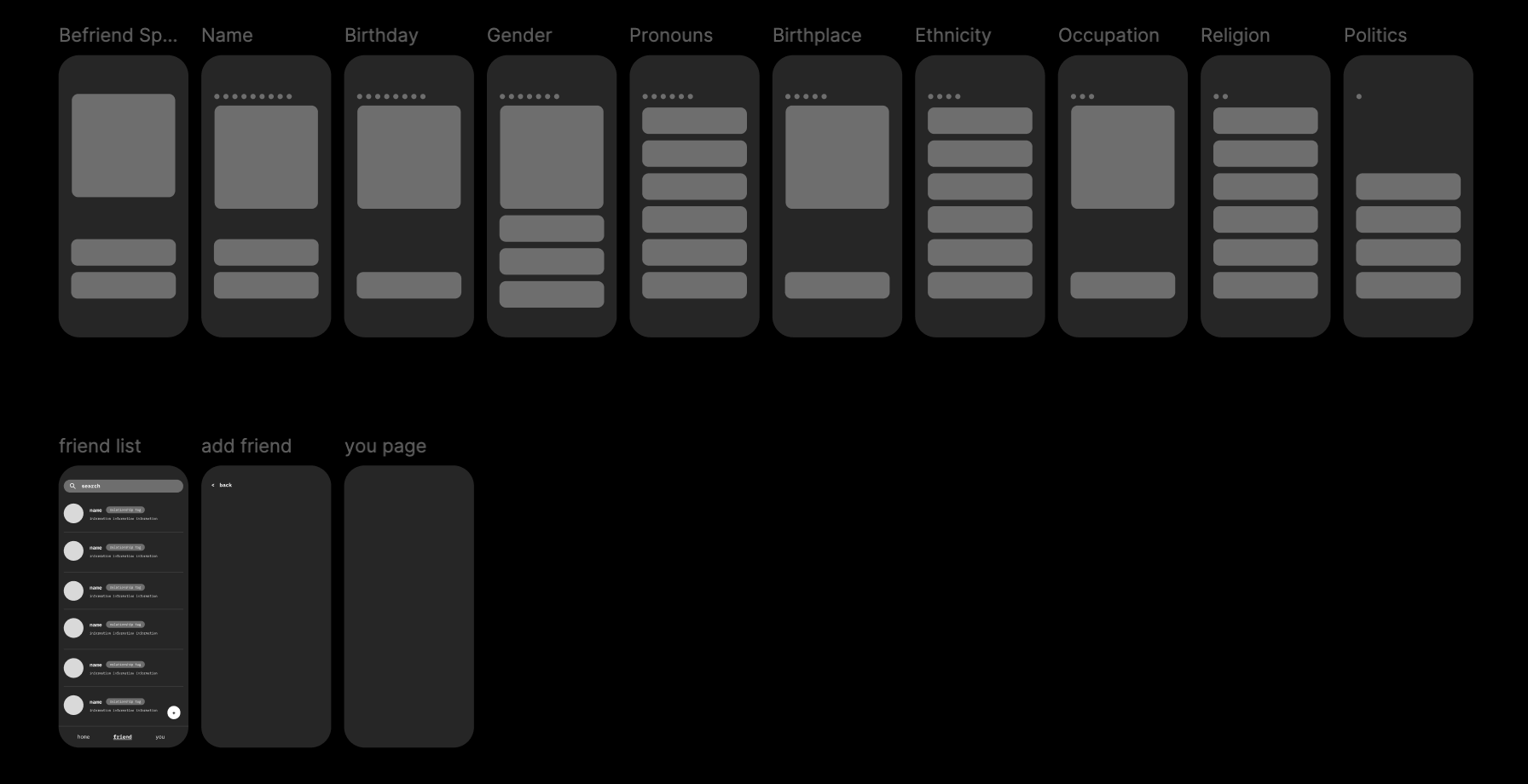
I used Gemini, Lovable, and Figma Make to generate rough structures and flow variations in parallel. This widened the solution space before the team committed to a single direction.
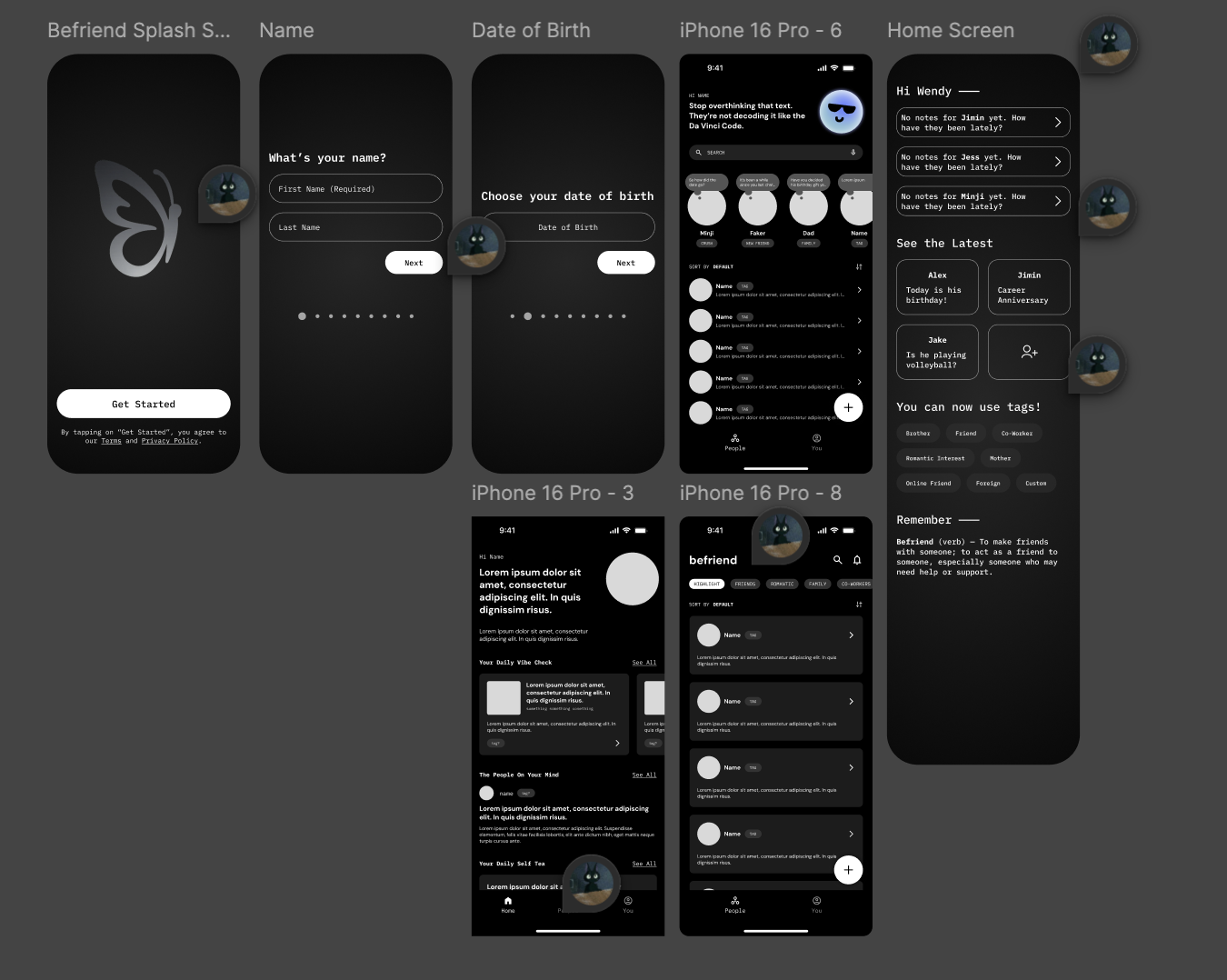
I then rebuilt and refined the strongest ideas in Figma, focusing on hierarchy, information flow, and the relationship between reflection, memory, and guidance. AI accelerated exploration; it did not replace design judgment.
Final design
The final experience follows the relationship between user and assistant over time, showing how useful context can grow without overwhelming the first session.
Day 1 — Onboarding
The first-time user flow guides users through initial setup, including identifying the first person they want to 'befriend' and setting baseline communication preferences. This establishes the context for AI-assisted reflection and interaction.
Day 1 - onboarding establishes the first relationship context and baseline preferences
Day 7 — Pattern recognition
By the end of the first week, users begin revisiting interactions, reflecting on recent experiences, and recognizing emerging patterns. The AI surfaces contextual insights, helping users notice subtle emotional dynamics in their interactions.
Day 7 - recurring signals begin to surface through reflection and memory
Day 30 — Personalized reflection
After a month of consistent usage, the AI has established sufficient context to provide deeper, personalized reflections. Users receive insights into recurring behaviors, communication habits, and opportunities for growth in their relationships, encouraging intentional and emotionally aware decision-making.
Day 30 - the system delivers more personalized reflection based on accumulated context
Collaboration
This project was completed by two designers. I shaped the product direction, interaction structure, and the core reflection, memory, and guidance flows. My teammate supported visual development, exploratory concepts, and refinement of the interface system.
Next steps
If developed further, the next phase would focus on improving memory transparency, giving users clearer control over what the assistant remembers and why specific reflections are surfaced over time.
I would also explore ways to make emotional guidance feel more grounded and less generic, including richer reflection prompts, more nuanced tone controls, and stronger safeguards around sensitive interpersonal situations.
Longer term, the product could evolve from a reactive advice tool into a more intentional reflective companion, helping users build healthier communication habits through repeated use rather than one-off moments of support.